
How can First Nations communities shape the clean energy transition as rights-holders, decision-makers and project owners?
In Session 8 of the JustRE Alliance Community of Practice on Community Ownership, the conversation turned to the experience of First Nations communities in Australia and the work being led by the First Nations Clean Energy Network.
The discussion featured Karrina Nolan and Jonathan Kneebone from the First Nations Clean Energy Network and was facilitated by Anna Biswas of Forum for the Future and Holle Wlokas of INSPIRE, both members of the JustRE Alliance Steering Group.
Rather than following a formal presentation format, Anna and Holle invited Karrina and Jonathan to reflect on their personal journeys, the origins and work of the Network, and the practical barriers to First Nations ownership and participation in renewable energy.
Karrina opened by acknowledging Wurundjeri Country, the land of the Kulin Nations, from where she and Jonathan were joining in Naarm, Melbourne. She situated the work of Original Power and the First Nations Clean Energy Network within the much longer history of First Nations peoples caring for Country and organising collectively as communities.
How did you come to do this work?
Anna began by asking Karrina and Jonathan to move beyond their formal biographies and explain what had brought them personally to this work.
Karrina described a long process of exploring different ways to create change. Her earlier work included supporting First Nations women through the Straight Talk programme, advocating with government, campaigning on climate change and working alongside communities opposing a proposed nuclear waste dump.
These experiences led her to focus increasingly on community organising and self-determination. She reflected that when communities strengthen the skills, leadership and resources needed to respond to one issue, those capacities can be applied to other priorities communities identify for themselves.
This belief became central to Original Power and later to the First Nations Clean Energy Network: First Nations communities understand the challenges they face and should be able to determine their own solutions. The role of others is to resource, connect and support that leadership.
Jonathan described his interest in the different tools available to create social change in the context of Australia’s history of colonisation and exclusion of First Nations peoples. He initially saw law as one such tool and worked alongside Traditional Owners on legal cases, commercial negotiations and economic development initiatives.
Over time, his work expanded to include finance, economics and policy. He described the clean energy transition as both an essential response to climate change and a process that could reproduce earlier patterns of dispossession and exclusion if First Nations peoples were not able to shape it.
The work of the First Nations Clean Energy Network
Responding to Holle’s question about the Network’s history and mission, Karrina explained that it emerged from conversations with First Nations communities across Australia about what the energy transition meant for them.
Many communities reported that they were not being included and often did not know that renewable energy or transmission projects were being planned until decisions were already well advanced.
The Network was established as a grassroots, member-based organisation to change this situation. Its work is organised around three connected priorities.
Community ownership in practice: the Marlinja microgrid
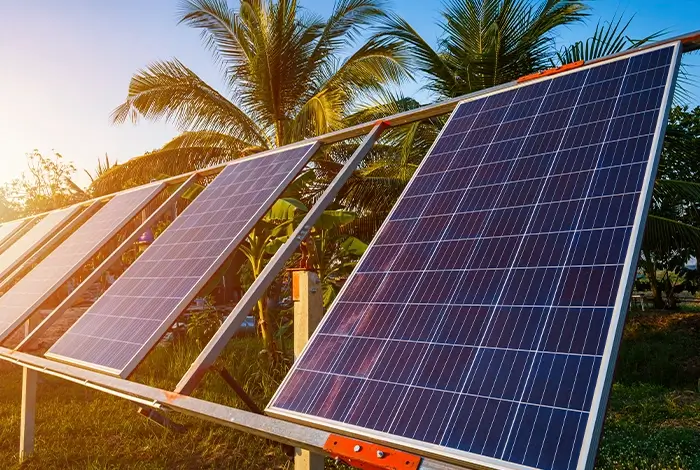
The session included a video about the Aboriginal-owned solar microgrid at Marlinja in Australia’s Northern Territory.
Community members described living under a prepaid electricity system in which power is disconnected when household credit runs out. Losing electricity affects lighting, refrigeration, cooling and, in some cases, access to water. The problem is particularly serious during extreme heat, storms and flooding.
The microgrid was designed so that electricity generated by the system provides credit directly to household meters. Community members described saving money, experiencing fewer disconnections and no longer having to constantly find funds for power cards.
Karrina explained that the project serves approximately 60 residents across around 20 houses and was developed through a long-term relationship with the community and philanthropic funding.
She also cautioned against presenting it as a model that could simply be copied everywhere. Microgrids will not be the right technical solution for every remote or diesel-dependent community, and individual philanthropic projects cannot replace the responsibility of governments and energy providers to deliver affordable and reliable services.
The project therefore demonstrates both what community ownership can achieve and the wider institutional barriers that must be addressed for these approaches to grow.
Barriers to ownership at scale
Holle then asked about the challenges and frontiers of the Network’s work.
Jonathan explained that many of the economic pathways available to non-Indigenous Australians remain inaccessible to First Nations communities. Communities may not have accumulated wealth, established banking relationships, large balance sheets or the capital needed to develop projects.
A major gap exists at the earliest stages. Before communities can attract commercial investment, they need funding for internal meetings, feasibility studies, technical advice, legal support and project design.
Both speakers discussed the need to reform public and private financing institutions. Although substantial government-backed capital is available for Australia’s clean energy transition, First Nations projects are often treated primarily as risks rather than opportunities.
Jonathan described part of the Network’s work as unravelling policy and investment systems that have historically excluded First Nations peoples and rebuilding them so communities can participate on different terms.
Key discussion points
Participants raised questions about offshore wind, finance, community priorities, trust and recent Australian policy developments.
On offshore wind, Karrina emphasised that First Nations peoples understand land, waters and sea Country as connected. The same principles therefore apply to offshore and onshore development: early engagement, consent, proper resourcing and strong community leadership.
Asked where a community seeking to develop its own energy model should begin, Karrina said the starting point should not be a technology or financial structure. Communities first need to define what they want.
Some may want cheaper and more reliable electricity. Others may want to move away from diesel, build a local workforce, participate in a nearby large-scale project or own an energy asset. Different objectives require different models and forms of support.
Participants also asked how communities without substantial assets could participate in ownership without taking on unacceptable financial risk. Jonathan shared an example of a Traditional Owner group that secured an equity interest in a battery project through a non-recourse loan, meaning the community’s other assets would not be exposed if the project failed.
The discussion also explored trust. Karrina noted that some communities question why they should host clean energy infrastructure when they did not cause climate change and may not receive direct benefits.
Jonathan emphasised that the Network is not a renewable energy project proponent. Its starting point is self-determination: communities should have the information, resources and choices needed to decide whether and how they want to participate.
Recent policy progress in Australia was also discussed. Karrina welcomed new funding and policy measures supporting First Nations participation but cautioned that implementation remained fragile. Jonathan added that First Nations outcomes were still too often treated as desirable additions rather than essential elements of the transition.
Key reflections
Several reflections emerged from the session:
As Session 8 highlighted, building community power requires more than inviting communities into projects that others have already designed. It means creating the conditions in which communities can define their priorities, make informed choices, negotiate on fairer terms and lead clean energy projects themselves.
Thank you to Karrina Nolan and Jonathan Kneebone for sharing their experiences, and to Anna Biswas and Holle Wlokas for facilitating the conversation.
Be part of our next CoP conversation
Stay tuned for our upcoming Community of Practice sessions. Sign up to stay in touch.
Sign up for the Community of Practice here.