
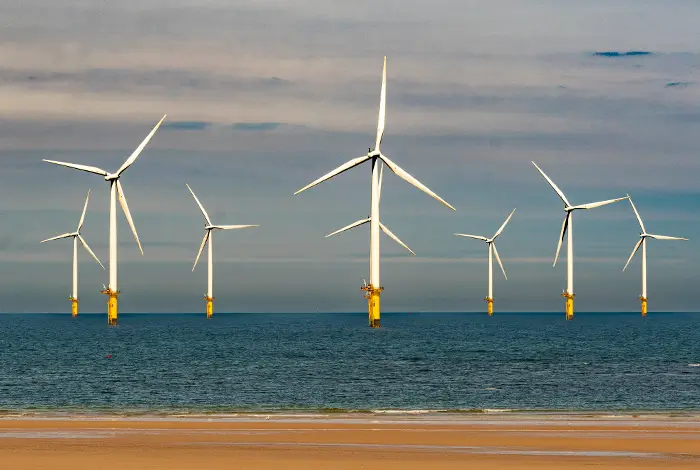
Community participation in large-scale offshore wind developments ultimately hinges on a practical question: how can local communities meaningfully share in the benefits of marine-based renewable energy projects while safeguarding their livelihoods and ecosystems?
In this session of the JustRE Alliance Community of Practice (CoP), participants explored how early engagement, participatory planning, and inclusive governance can shape more just and equitable offshore energy transitions.
Co-facilitated by Holle Linnea Wlokas (INSPIRE) and Juanita Fonseca (JustRE Alliance), the session brought together perspectives from Scotland, Colombia, and Southern Africa, with contributions from Lisandra Matos (SEI), José Vega Araújo (SEI Latin America), and Lesedi Komi (independent consultant).
Offshore wind and fishing communities in Scotland
Drawing on Scotland’s experience as a mature offshore wind market, Lisandra highlighted the challenges of enabling coexistence between offshore wind developments and traditional fishing livelihoods.
Key issues include temporary disruptions during construction, restricted access to fishing grounds, and cumulative impacts across multiple projects. In response, mechanisms such as Fisheries Liaison Officers (FLOs) have emerged to mediate between developers and fishing communities, alongside evidence-based compensation systems.
However, the session emphasized that fishing is often tied to deep cultural identity and intergenerational practices, meaning that financial compensation alone is insufficient. Strong fisher associations play a critical role in representing community interests and enabling more effective participation.
Colombia’s offshore wind roadmap and the COAST-Wind tool
José presented Colombia’s emerging offshore wind sector, with ambitions to reach 7 GW of capacity by 2040, primarily in the Caribbean region.
Recent regulatory developments include the country’s first competitive tender for offshore wind areas, as well as early efforts to embed benefit-sharing, such as a Technical Skills Transfer Program requiring developers to support local workforce development.
A key focus of the presentation was the COAST-Wind (Colombia Ocean Activity Sustainability Tool), developed by SEI Latin America to support sustainable ocean planning and offshore wind siting.
The tool integrates human activity data and environmental sensitivity analysis to produce a Marine-Coastal Susceptibility Index (MCSI), helping identify areas of higher or lower socio-environmental conflict.
Currently under development, COAST-Wind combines:
By linking technical planning with socio-ecological realities, the tool aims to strengthen Marine Spatial Planning processes and support more informed and inclusive offshore wind development.
Emerging offshore wind opportunities in Southern Africa

Lesedi reflected on early-stage offshore wind developments in Namibia and South Africa, where the sector is gaining attention alongside broader ambitions around energy security and green hydrogen.
While projects remain in the exploratory phase, key challenges include fragmented policy frameworks, limited infrastructure readiness, and long project development timelines.
From a social perspective, Lesedi emphasized that coastal areas are not just technical sites, but lived landscapes shaped by livelihoods, identities, and cultural practices.
Effective community participation therefore requires:
In this context, participation is central toIn this context, participation is central to building trust, avoiding conflict, and ensuring long-term project viability.
Key reflections
Across regions, several shared insights emerged:
Closing reflections
The session underscored that offshore wind’s success depends not only on technical feasibility, but on the social contracts that underpin project development.
Embedding participation, transparency, and community agency throughout project lifecycles is essential to transforming offshore wind into a driver of shared value and long-term resilience.
Continue the conversation
Join us in upcoming JustRE Community of Practice sessions as we continue to explore pathways toward community-driven renewable energy transitions, including Indigenous participation, local governance, and equitable ownership models.
Session 7: We will discuss Indigenous Dialogue in Wind Energy: Insights from Brazil and Colombia. This session shares reflections on territorial governance and community participation based on direct exchanges between Indigenous territories.
Sign up for the Community of Practice here.