
Home » Trauma-Informed Approaches to Community Ownership in Large-Scale Renewable Energy

Trauma-Informed Approaches to Community Ownership in Large-Scale Renewable Energy

Session 5 Recap: Community Ownership in Practice
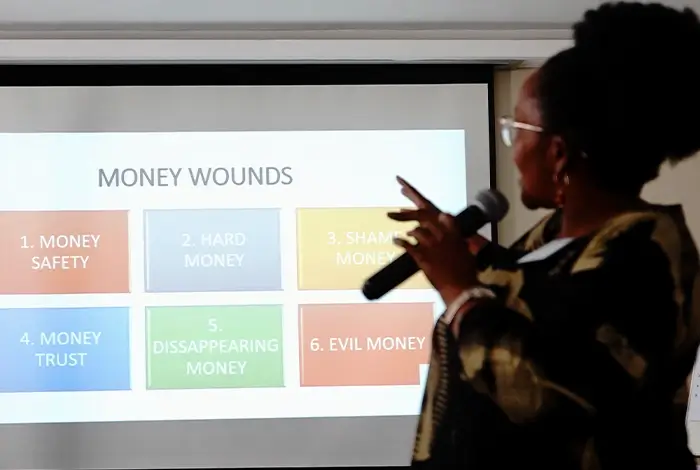
Dr. Nomfundo Mogapi, Clinical Psychologist and CEO of CMWL, presenting on trauma-informed governance and leadership strategies during a professional conference.

Community ownership in large-scale renewable energy ultimately raises a deeper question: how can communities exercise real power and agency in contexts shaped by historical trauma and mistrust?

In Session 5 of the JustRE Alliance Community of Practice (CoP) on Community Ownership, the conversation turned to the human and psychological dimensions of equity shareholding. The session explored how trauma-informed approaches can strengthen governance, leadership, and trust in renewable energy projects in the Global South.

Hosted by Juanita Fonseca, Coordinator of the JustRE Alliance, the session examined how community ownership unfolds in what the speaker described as “wounded contexts”: places where histories of colonialism, extraction, and exclusion continue to influence relationships with power, development, and investment.

The discussion was facilitated by Holle Linnea Wlokas, Co-Founder and Managing Director of INSPIRE (South Africa), who connected the conversation to the Alliance’s broader work on social excellence and justice in the energy transition.

The main presentation was delivered by Nomfundo Mogapi, Clinical Psychologist and CEO of the Centre for Mental Wellness and Leadership, who shared insights from her experience supporting trauma-informed leadership and governance processes in post-conflict and post-colonial contexts.

Key Presentation Themes

The Paradox of Development in Wounded Contexts

Renewable energy projects are often implemented in communities where deep-seated trauma and mistrust already exist. While projects may bring significant financial investment and infrastructure, meaningful social outcomes remain difficult to achieve when psychological infrastructure is weaker than the technical or financial systems supporting the project.

Psychological infrastructure includes elements such as trust, emotional safety, and leadership capacity. When these foundations are weak, trauma may manifest through mistrust, conflict, and governance paralysis, making collaboration and decision-making difficult.

Addressing these dynamics requires emotional literacy, trauma-informed leadership, and deliberate efforts to rebuild trust within community governance structures.

Historical and Structural Trauma

In many regions, colonial histories and extractive economies have created enduring “psychological architectures of mistrust.” Examples from South Africa and Sierra Leone illustrate how development initiatives—particularly those led by actors from the Global North—can unintentionally reactivate historical wounds.

The speaker also noted how broader societal pressures, including the lingering effects of COVID-19, have intensified chronic stress and survival-mode decision making within many communities.

Recognizing these structural dynamics is essential for advancing meaningful community ownership and participation in renewable energy projects.

Trauma-Informed Governance and the “4 Rs” Framework

The session introduced the “4 Rs” framework of trauma-informed practice, which encourages organizations and leaders to:

  • Recognize the presence and impact of trauma
  • Realize how trauma affects individuals and systems
  • Respond by integrating this understanding into governance and engagement processes
  • Resist re-traumatization by ensuring development processes do not replicate harm

Trauma-informed governance requires leaders to cultivate self-awareness, emotional regulation, and the ability to create psychologically safe spaces where dialogue and collective decision-making can take place.

Money, Power, and Survival Responses

Large financial inflows can unintentionally intensify existing tensions in communities shaped by trauma. In these contexts, access to funds may trigger survival responses such as competition, distrust, or scapegoating.

Trauma can also shape how individuals relate to power and authority, sometimes leading to its misuse, avoidance, or paralysis within governance systems.

The speaker emphasized that preventing these dynamics requires transparent communication, strong accountability mechanisms, and carefully designed governance structures.

Organizational Trauma and Leadership

Trauma also affects organizations working with communities. Community trusts and NGOs often focus heavily on delivering impact while overlooking the importance of internal systems and organizational culture.

This imbalance can lead to internal conflict, governance challenges, and unhealthy working environments. Addressing these issues requires trauma-informed organisational development, including governance structures, HR practices, and operational systems that promote transparency, psychological safety, and accountability.

Practical Interventions and Case Examples

A case from Tsitsikama, South Africa, illustrated how trauma-informed leadership training can transform governance dynamics. Prior to the intervention, meetings between community leaders frequently collapsed into conflict and communication breakdowns.

Introducing grounding exercises and emotional regulation practices enabled leaders to conduct constructive and peaceful meetings for the first time.

The speaker also noted the importance of adapting language to different audiences. Framing trauma-informed approaches in terms of risk management, organizational culture, or leadership effectiveness has proven effective in engaging private sector and government actors.

Key Discussion Points

Participants discussed practical ways to integrate trauma-informed approaches into renewable energy governance and engagement processes.

Several themes emerged:

Adapting language was identified as critical when engaging technical or private sector stakeholders. Positioning trauma-informed practices as tools for risk management and organizational performance can strengthen institutional buy-in.

Participants also emphasized the importance of transparency and accountability in building trust with communities, particularly in relation to equity shareholding structures and benefit distribution. One suggestion was the use of “promise audits” to track whether commitments made to communities are actually fulfilled.

Monitoring and evaluation frameworks were also discussed. Participants noted that traditional evaluation methods often focus primarily on financial indicators, while trauma-informed approaches encourage the inclusion of indicators related to governance participation, social cohesion, and psychological safety.

Finally, the conversation acknowledged the emotional demands placed on social performance practitioners. Practices such as healing circles, coaching, and reflective spaces were identified as valuable tools for supporting practitioner resilience.

Key reflections

Several reflections emerged from the session:

Justice requires healing

A just energy transition must address not only structural inequities but also the emotional legacies of historical trauma.

Internal and external transformation are interconnected

Organizations must cultivate trauma-informed cultures internally while supporting communities to strengthen leadership and governance capacity.

Language shapes adoption

Framing trauma-informed approaches in terms of risk management, organizational culture, and leadership effectiveness can strengthen institutional uptake.

Trust is foundational

Transparent communication, cultural sensitivity, and realistic commitments are essential to rebuilding trust in historically marginalized contexts.

As Session 5 highlighted, advancing social excellence in renewable energy requires recognizing the psychological realities that shape community participation and ensuring that governance processes actively rebuild trust, psicological safety, dignity, and collective agency.

What’s next in the CoP

We are excited to continue this journey together. Mark your calendars! Our 6th Community of Practice session is scheduled for April 9th, where we will continue to dive deeper into community ownership and social excellence.

Sign up for the Community of Practice here.

Tags: energy justice, Psychological safety, , Wounded contexts
Join to our Newsletter