
Home » Pioneering Indigenous equity partnerships in large-scale renewable energy in Latin America

Pioneering Indigenous equity partnerships in large-scale renewable energy in Latin America

Session 2 Recap: Community Ownership in Practice
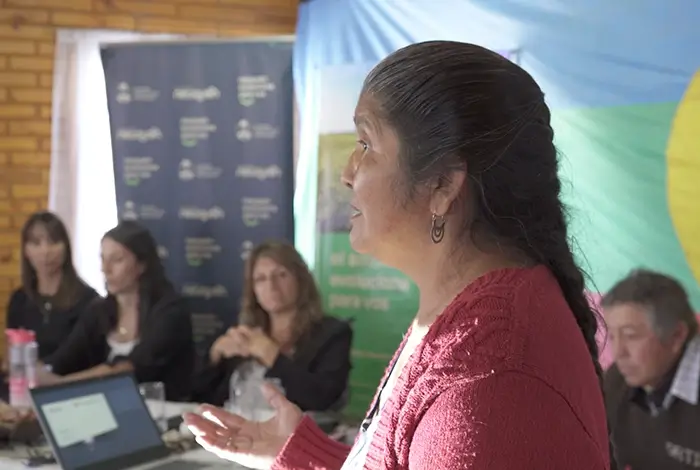
Nora Romero, a representative from the Mapuche Millaqueo community, addresses participants during the public hearing for the Environmental Impact Assessment (EIA) of the Antú I Solar project.

Why this conversation matters

The JustRE Alliance Community of Practice (CoP) exists to turn the idea of community ownership into implementation at scale. In Session 1, we aligned on what “community ownership” means and surfaced four pillars for making it real: define the model, start FPIC early and treat it as ongoing practice, plan for capacity on both sides, and align finance.

Session 2 built on that foundation with practice-grounded presentation by Juan Dumas (co-founder, Meliquina), facilitated by Yumnaa Firfirey, Director of Towards Uhuru. The session focused on how Indigenous communities can become genuine equity partners in utility-scale projects—moving beyond social investment to shared risk, shared governance, and shared returns.

The case: Antú I Solar with the Mapuche Millaqueo community (Argentina)

Juan presented Antú I Solar, an 18 MW PV project in northern Patagonia, co-developed by three partners:

  • Millaqueo (Mapuche) community — ~38 families (~150 people) organized as an association
  • Meliquina — community-equity partnership developer
  • Sustentar Energía — technical renewable-energy partner

What makes it different

Co-development from day one

The team approached Millaqueo not with a pre-packaged project, but with a business invitation: “If you’re not interested, that’s okay—this only moves forward as a partnership.”

FPIC as consent, not consultation

Because the community is a co-developer, consent is embedded: access to the same data, involvement in every material decision, and the right to say no.

Site selection reversed

The process began by mapping exclusions—sacred places, cemeteries, ceremonial zones, and sensitive ecosystems. Only then did engineers search for a viable site outside those zones.

Real milestones secured

Studies completed, land lease signed, grid connection point obtained, and environmental license granted. The project is now investor-ready.

Ownership & finance in practice

During development, partners agreed to recognize sweat equity—the value each brings before construction finance. The development company was split equally (community ~34%, Meliquina ~33%, Sustentar ~33%).

At construction, a major equity investor and bank debt will enter. This typically dilutes early developers dramatically. The team is exploring financing solutions so the community can retain a significant minority stake (and therefore influence), even if that requires prudently structured debt.

Crucially, equity is not granted for free and not a quid-pro-quo for “not opposing”. The community is a business partner that adds measurable value.

How communities add value (beyond land)

Co-development work

(e.g., constructive engagement with authorities helped accelerate environmental permitting—time is money).

De-risking and investability

(investors and DFIs favor projects with credible social performance and shared value; opposition risk falls when the community itself is inviting investment).

Market access

(communities can open doors with regional off-takers who might not engage with a small standalone IPP but will engage with a respected local partner).

Land lease as capital

(the net present value of a fair, long-term lease can be contributed as part of the community’s equity).

Timeline reality check

2018

Initial engagement began, but the community lacked formal land title, which proved pivotal.

2019

Political turbulence and the pandemic introduced unavoidable delays.

2022

With land title secured, full development ran through 2023–2025, which is broadly typical for a project of this size in that context.

2025

Environmental license and connection permits approved. Plans to start construction in 2026.

Enablers & constraints (and what to do about them)

From the developer’s perspective

  • Partner due diligence matters. Not every community is ready to co-own a utility-scale asset today. Meliquina uses a readiness lens that looks at governance systems, basic financial management, women’s participation in decision-making, relationships with neighbors and authorities, and more. Gaps are normal; the question is whether they can realistically be bridged with support.
  • Leadership is catalytic. Visionary, trusted community leaders who share decision-making and are curious about new models can accelerate learning and alignment.
  • Policy uncertainty is survivable. The team stopped trying to “time politics” and focused on building investable projects that can attract either international capital when markets are open or domestic capital when they are not.
  • Land ownership helps, but it’s not the only path. Antú I Solar benefits from community-owned land; however, there are other ownership pathways where land is state-owned or privately held (to be explored in a future CoP session).

From the community’s perspective (implied in the dialogue)

  • Equal partnership means equal information. Access to models, contracts, and data—plus the patient capacity-building to use them.
  • Sweat equity is real equity. Contributions must be recognized in the capitalization structure, not just applauded in a CSR report.
  • Governance agreements are essential. If final equity ends up small, robust governance rights (vetoes on key issues, reserved matters, information rights, fair dividend policies) protect long-term interests.
You may be interested in

What conventional developers ask—and how this model answers

“Doesn’t this take longer?”

A little—up front. But co-development can shorten later phases by reducing conflict, speeding permits, and stabilizing operations.

“What’s the business case?”

Lower social risk, stronger DFI appetite, differentiated market access, and a pipeline advantage on community-controlled land—plus the reputational upside of doing the right thing the right way.

“Isn’t equity for communities a giveaway?”

No. Equity is earned through value creation (co-development, lease value, market access, risk reduction), and when needed, financed prudently.

Quotes that stuck with us

JustRE Alliance South Alliance for a Just Transition to Renewable Energy
Juan Dumas
co-founder, Meliquina

“This is not energy access. It’s about communities participating as economic players in the energy transition.”

JustRE Alliance South Alliance for a Just Transition to Renewable Energy
Juan Dumas
co-founder, Meliquina

“We want investors to put on their business hat. If this isn’t competitive, it will stay boutique and won’t scale.”

JustRE Alliance South Alliance for a Just Transition to Renewable Energy
Session reflection

“Begin with what is sacred and untouchable, and only then ask what is feasible.”

Practical takeaways you can use tomorrow

Flip your E&S workflow

Map exclusions (cultural & environmental) first; site selection comes after.

Make FPIC continuous

Treat consent as a co-development process, not a one-off consultation.

Price sweat equity

Name and quantify the community’s contributions early. Put it in the model.

Design for dilution

Pre-plan how the community retains a meaningful minority at financial close (e.g., dedicated community equity facilities, guarantees, step-in options).

Build two-way capacity

Train community leaders in project finance—and train developers in community governance and Indigenous rights.

Do readiness checks—together

Use a transparent, co-created tool to spot gaps and agree on how to bridge them.

What’s next in the CoP

Session 3: Community Ownership in Practice

Capacity building for community ownership

Supporting community capacity development for meaningful ownership at the pre-development and operational stage of large-scale RE projects.

Sign up for the Community of Practice here.
Tags: Argentina, Co-development, ESG Risk Management, Indigenous Rights, Project Finance, Sweat Equity, Utility-Scale Renewables
Join to our Newsletter